
Andrew Moshirnia's blog

The MPAA Lottery: Town of Coshocton Draws the Black Spot

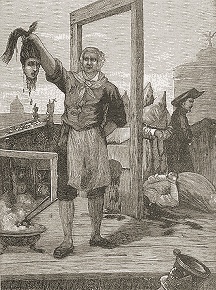
“’It isn’t fair, it isn’t right,' Mrs. Hutchinson screamed, and then they were upon her.”
- The Lottery, Shirley Jackson

In The Lottery, Shirley Jackson explored the interplay of the banal and the barbaric. She described a town’s old-fashioned agrarian ritual: an individual who has drawn a slip marked with a black spot is stoned to death in order to ensure a good harvest. While many filmmakers have attempted to update the story, their efforts were ultimately unnecessary – we bear witness to a similarly atavistic ritual.

The entertainment industry is a superstitious animal. Since I can remember, it has held a lottery: selecting at random file sharers to pelt to death with stones marked TORT and BREACH. Though the human sacrifice doesn’t seem to do much, the industry has continued the practice year after year. This is how it had always been. Though peculiar, this practice seems to elicit only mild revulsion in outsiders.  That is, until last week, when the lottery suddenly changed .  .  .    read more »

The Cartman Technique: How a Fraud Exception will Mine the ISP Safe Harbor

[A]ll it takes to kill a show forever, is to get one episode pulled. If we convince the network to pull this episode for the sake of Muslims, then the Catholics can demand a show they don't like get pulled . . . and so on and so on, until Family Guy is no more - it's exactly what happened to Laverne & Shirley.- Eric Cartman, South Park , Cartoon Wars I

It doesn’t take much to whittle away a law. One need only use the Cartman technique – ask for one exception and wait for others to follow. It is death by a thousand cuts on the legal stage.   read more »

The Online Odyssey: Internet Use in the Age of HADOPI's Scylla and Holder's Charybdis

Last week was a tough one for Internet users worldwide. On the foreign front, the French (as predicted) reinstituted a due-process-shattering law that allows ISPs to kick suspected file-sharers off the Internet.  On the domestic side, a district court refused to lift a government gag order, preventing ISPs from discussing the FBI’s Internet snooping. Separately, each of these events is a bummer, but taken together they threaten the Internet as we know it by inviting abuse from both private industry and government.

As you may recall, the French government (with a little encouragement from the entertainment industry) has previously attempted to do away with the entire notion of due process vis-à-vis the Internet. The HADOPI law would have allowed ISP’s to strip Internet access from users who were accused of file sharing. The French Socialist party challenged the law, arguing that access to the Internet was a basic right that could not be violated without judicial oversight. The Conseil Constitutionnel agreed and declared the banning provision unconstitutional.   read more »

NEEEEEDDDD BRAAAAINNS: MPAA Resurrects Plan to Take the R Out of DVRs

Between sparkling vampires and slobbering zombies, the Undead have found new life at the box office these days. So it makes sense that the MPAA, inspired by the success of the long deceased, has decided to resurrect the odorous, oft-defeated idea of “selectable output control.” We can only hope and pray that the FCC will shoot this idiotic (but dangerous) idea in the head, and grant consumers a brief respite (before the inevitable sequel). For those of you who are unaware of the movie industry’s idiotic plan to castrate and consume your DVR, allow me to shine a light on the lumbering terror.   read more »

Cyber-Bully Pulpit: Government Sponsored Online Shaming

While a number of businesses and organizations are initiating public service campaigns to combat cyberbullying, governments are realizing the utility of online shaming.

In response to a rash of recent suicides, the French Labor Minister, Xavier Darcos, has directed over two thousand French firms to craft anti-stress strategies with the aid of unions by 2010.  Companies who do not have a plan in place by the deadline will be named publicly on a dedicated government website.

Now right off the bat, let’s acknowledge that this approach to suicide is fairly awesome. First, the government is aggressively addressing an insidious problem. Second, a public listing seems to be the only sanction for those companies that fail to comply.  We’re bringin’ shaming back!   read more »

Sorry Jack Thompson, Your Comprehension of Section 230 Is in Another Castle!

On this blog, I typically write about frivolous or ill-considered lawsuits. In the long, long ago, before I came to law school, I wrote about video games. So imagine my unbridled joy upon reading that Jack Thompson (think: King Richard I of the Anti-Video Game Crusade) filed a pointless, dead-end  lawsuit against Facebook.  Let the Games Begin!   read more »

I Can Clearly See You’re Nuts: ACORN’s Insane Civil Suit

I'm pretty sure I can struggle my way out. First I'll just reach in and pull my legs out, now I'll pull my arms out with my face. – Homer J. Simpson, The Simpsons, Bart Gets An Elephant, 1F15

Weaseling out of things is important to learn. It's what separates us from the animals! . . . except the weasels.  – Homer J. Simpson, The Simpsons, Boy Scoutz ‘N the Hood, 1F06

I provide these quotes because I can only assume that ACORN has retained Homer Simpson as its general counsel (R.I.P. Lionel Hutz) in what may be the most ill-considered lawsuit of all time.  The cartoon patriarch doesn’t know when to quit and thinks that responsibility can always be shirked. After learning of ACORN’s decision to sue James O’Keefe, Hannah Giles, and breitbart.com for wiretapping, I concluded that the disgraced community organization shares Homer’s sensibilities.

Background: The Association of Community Organizations for Reform Now (ACORN) is an amalgam of several organizations and non-profits that serve low- and middle-income populations. ACORN’s support of Democratic candidates and Left-leaning policies, as well as allegations of financial and electoral misconduct, have earned ACORN the ire of conservatives.    read more »

Anthropomorphizing Intrusion: Google Street View and the Armies of Cute

A basic lesson of history: a spoonful of cute helps the social medicine go down.

Bert the Turtle prepared us for Global Thermo-Nuclear War. Bugs Bunny and Donald Duck helped us hate the Nazis and (briefly) like Stalin. Now Google has harnessed the power of cute to sell Google Street View.  I think the approach will work in Japan and America, for Europe I’m not so sure.   read more »

Weight Watchers from Hell – Iran’s New Method for Slimming Tortured Bloggers

A little while back, I wrote about the Iranian persecution of bloggers and opponents of Mahmoud Ahmadinejad. There is so much evidence of this systematic assault on liberty that it was difficult to pick just one Exhibit A. I finally settled on the before and after pictures of Mohmmad Ali Abtahi, which showcased the effects of torture on a former vice president and leading cleric-blogger. The image of a formerly rotund, sanguine Abtahi transformed into that of a haggard immate seemed the easiest way to confirm allegations of mistreatment of political detainees.

No so fast, said Abtahi’s jailers. According to the New York Times, Ali Akbar Javanfekr, President Ahmadinejad’s adviser for press affairs, said that these pictures point not to torture but to self-improvement derived for deep contemplation. Javanfekr, apparently with a straight face, argued that “[i]t is only natural for a person who has gained an excessive amount of weight to come to his senses in prison that being overweight is not good for your mental or physical health.”   read more »

Cybernetic Cain: In the Eyes of the Internet Law, You Are Your Brother’s Keeper

CainLet’s review the two basics of modern criminal law:

  1. The law punishes you for your individual crimes, not the crimes of your ethnic, religious, or kin group. If your father kills someone, you don’t follow him to jail. (Usually.)
  2. The law does not take away your freedom or valuable property without giving you some sort of reasonable pre-deprivation hearing. (Think a trial, see Mathews v. Eldridge, 424 U.S. 319 (1976)).

I’m sorry to bore you with these mundane/obvious details, but it seems that various governments have forgotten these simple rules when it comes to crafting cyberlaw.

You might recall the Internet-banning HADOPI law that made the rounds in France before being defeated by the Socialists. That law sought to block users from the Internet if they had been accused (not convicted) of illegal file sharing. The Conseil Constitutionnel struck it down, holding that Internet access was a fundamental right.   read more »

Florida Nukes the Fridge: Facebook, the Bar, and the Latest Entry in the Social Network Hijacking Saga

It’s rarely a good sign when a series grows beyond a trilogy. You end up with pod racing, fridge nuking, and Winona Ryder.  So I was happy to stop writing about privacy on social networks after the cyber-possession trilogy: the Facebook snatching government employers in Bozeman, the MySpace lurking managers of Houston’s, and the Twitter brandjacking PR Firms.  So imagine my double displeasure when I found out that the Florida Board of Bar Examiners decided to start demanding access to the Facebook accounts of red-flagged applicants.

Damn it, FBBE. This is why we can’t have nice things.   read more »

Wikipedia's New Review Process: Closing the Libeler’s Playground


Wikipedia is growing up and exercising more control over its content. In years past, the free encyclopedia provided me with such jewels as an exegesis of Smurf Communism (long since removed). More importantly, Wikipedia helped keep us at CMLP busy, by serving as the equivalent of a libeler’s attractive nuisance, providing an easily accessible platform for defamers the world over.  The defamed would sue their defamers, and often (futilely) go after Wikipedia as well, providing us with a bevy of opportunities to document the “hey-isn’t-this-strangelegal threat and the general ignorance of Section 230.

But all good things must come to an end. Yesterday, the Wikipedia Foundation announced that the English-Language site would now flag all proposed edits to * currently locked pages of live individuals.  Contributors used to the intoxicating immediacy of Wikipedia editing might need to get used to waiting * for editor approval. This system has already been in place for a year in the German-Language Wikipedia (ah, those order-loving Germans).     read more »

Out of the Frying Pan and into the Mildly Uncomfortable Sauna: The Not-So-Bad-But-Still-Unconstitutional Social Networking Ban


The memory of pain can be one of the best painkillers. Anyone who has had the misfortune of enduring acute physical agony has later repurposed that nightmare as a psychic analgesic. “This needle might hurt, but it's nothing compared to that time I broke my arm. I can do this.” Previous extremes make the mild more bearable. This holds true for a surprising number of situations: long plane delays, expensive fines, and now sex-offender Internet bans. (Don’t worry if that last category didn’t make too much sense, I’m just about to explain.)

A week ago, Illinois Governor Pat Quinn signed a bill, HB 1314, making it illegal for convicted sex offenders to access a “social networking website,” defined as:   read more »

The New Intellectual Arms Trade: Amazon and B&N as Literary God-Emperors

When we were kids, we couldn’t wait for the future to hurry up and get here. Flying cars, pills for food, conveyor belts, the works. What we didn’t understand was that the future would arrive in pieces: the everywhere computer (iPhone), the million channel TV (YouTube), the all-knowing answer machine (Wikipedia), and the hive mind (Twitter). These wonders didn’t arrive in a big box marked “Future,” but appeared one at a time.  Sometimes the future is so discreet, you don’t realize you are living in it.   read more »

Internet Amputation and Digital Death: Are Decade-Long Internet Bans Constitutional?

Quick rule of thumb:  when a judge is looking to perform an experimental legal amputation, that judge will vivisect a child molester.  It’s easy to take away the rights of someone who has acted in such a bestial, inhumane manner. One of the problems with this practice is that these restrictions are later visited on less horrible people. They come first for the pedophiles, but then they may come for you.

I have written about the judicial practice of imposing Internet prohibitions on sex offenders and wondered if a court would uphold such restrictions on appeal.  A recent decision by the Third Circuit, United States v. Thielemann, affirmed a decade-long ban on Internet use for a pedophile and forced me to revisit the question.   read more »

The Show Must Go On: Iran’s Mass Trial and its Losing War on Bloggers

Iran’s campaign to protect the results of the June 12 double-plus democratic election of Mahmoud Ahmadinejad shifted into a new gear on Saturday when the regime began the mass trial of more than 100 individuals arrested for their alleged involvement in protests and post-election violence. Iranian leaders likely hope that the trial will serve as a stiff warning to potential protestors, and to Iranian bloggers in particular. But reactions to the regime’s latest game of whack-a-blogger have been anything but muted.   read more »

The AP of Oz: Associated Press Prohibits Reporters from Peeking Behind its False DRM Curtain

Last Friday, the Associated Press briefly became the Great and Powerful Wizard of Oz. It announced, in a booming press release, an “initiative to protect news content from unauthorized use online.” To accomplish this feat, the AP will use an informational “wrapper” embedded in its product. At first I was terrified and angered by the Great and Powerful AP’s announcement, as were the other members of the lollipop blogger guild. After all, this plan sounded like digital rights management. Would the AP begin erecting pay walls and chasing news pirates?   read more »

The Future of Digital Book Burning: Why Remote Line-Item Retraction is Scarier than Remote Volume Deletion

Amazon did its best impersonation of Big Brother last week, when it reached into Kindles the world over and remotely deleted copies of Orwell’s Nineteen Eighty-Four and Animal FarmWitty title writers thanked their lucky stars and began stamping out stories comparing Amazon to the Ministry of Truth. Once again, the Twitterati mercilessly mocked Amazon. Double-Plus Outrage ensued.  read more »

An Inter-Newspaper Cease-and-Desist Letter: My Trip to the Buffet of Wrong

Buffets are monuments to the tyranny of choice.  When presented with a plethora of options, many people just freeze up -- stopping somewhere between the crab claws and the gelato bar.  Today I found myself in a similar overwhelmed position as I read Platinum Equity’s cease-and-desist letter to the San Diego Reader. You see, there are just so many shockingly wrong aspects of this attempt to chill speech, it was hard to pick just one to harp on.  read more »

Brandjacking on Social Networks: Twitter, Malicious Ghost Writing, and Corporate Sabotage

It seems all I can write about these days is digital doppelgangers. I’ve written about employers engaged in Facebook hijacking and MySpace lurking. Today, a story of brandjacking through Twitter sabotage rounds out the cyber-possession trilogy.

Ghost writing on Twitter is nothing new.  When you tweet with 50 Cent or Britney, you are communicating with a publicist. This just seems to come with the territory of celebrity communication. Maybe that is why most people derided the story of Tony LaRussa’ s suit against Twitter in reaction to a malicious ghost-tweeter.   read more »


Copyright 2007-09 Citizen Media Law Project and respective authors. Except where otherwise noted,
content on this site is licensed under a Creative Commons Attribution-Noncommercial-ShareAlike 3.0 License: Details.
Use of this site is pursuant to our Terms of Use and Privacy Notice.