

Eric P. Robinson's blog

As Politicians Adopt Social Media, They Bump Into the Law

As social media become more popular, it is inevitable that enterprising politicians will use it promote themselves, connect with constituents, and garner votes.  The White House has a blog, several Senators and House members tweet, and elected officials and candidates at all levels of government are using social media to get out their messages.

But just as use of social media by voters is coming into conflict with existing election laws, some politicians are discovering that their use of social media may clash  — or at least create possible problems — with existing campaign and government disclosure laws.   read more »

New FTC Rules Aim to Kill the Buzz on Blogs

On October 5, the Federal Trade Commission issued new guidelines (large pdf) on advertising involving endorsements and testimonials. The guidelines, which are due to go into effect on December 1, have caused a stir among bloggers, journalists, and new media types because they appear to place significant requirements and restrictions on blogs and social media.  Most notably, they suggest that bloggers or other consumers who "endorse" a product or service online may be liable for civil penalties if they make false or unsubstantiated claims about a product or fail to disclose "material connections" between themselves and an advertiser. (Although Richard Cleland, assistant director of the FTC's  division of advertising practices, told Fast Company that the Commission will focus on warnings and cease-and-desist orders, rather than monetary fines, and told PRNewser that the Commission will target advertisers for violations, not bloggers. Another FTC official reiterated this.)   read more »

For Once, Illinois Federal Judge Lets 'Em Roll: And Gets Bulldozed

UPDATE:  Federal District Judge Joe Billy McDade has issued a letter apologizing for allowing cameras into his courtroom to cover a Sept. 15 hearing on a consent decree settling a school discrimination case.

The apology came after Judge Frank Easterbrook, chief judge of the 7th Circuit, issued an opinion chiding Judge McDade for allowing cameras into a consent decree hearing in a school discrimination case, saying that it violated a 1996 resolution of the 7th Circuit Judicial Council adopting the national Judicial Council's ban on cameras, discussed below.

The video, available on the local newspaper's web site, is of a hearing on the final consent decree in a federal lawsuit that alleged racial discrimination in the public schools of Champaign, Illinois.     read more »

Mi Casa Es Su Casa — But I Set the Rules

Paul Klocko got a surprise in the mail in April: a letter on official stationary from Weston, Wisconsin administrator Dean Zuleger, demanding that Klocko stop posting comments on the web criticizing him.  The letter also asked that Klocko "come out from behind the cloak" and meet Zuleger in person.

The letter was surprising because Klocko had posted his comments on the web site of the Wausau Daily Herald using a pseudonym, "juanmoore."  But when Zuleger contacted the newspaper, demanding that it identify his anonymous critic, the Daily Herald gave him Klocko's real e-mail address, which Klocko had provided when registering as a commenter on the site and which contained his true name. 

The newspaper apologized to Klocko over the summer, and its parent company, Gannett, clarified that its policy was to release information on anonymous commenters only when ordered by a court or when a comment threatens imminent harm.   read more »

Southeastern Conference Sacks Social Media, Then Recovers

Responding to a storm of criticism, the 12-university Southeastern Conference was forced to back away from proposed rules which would have prohibited fans from blogging, Twittering, instant messaging, or otherwise disseminating "any material or information about [its sports competitions], including, but not limited to, any account, description, picture, video, audio, reproduction or other information concerning the Event."

In response to the criticism, the Conference quickly came up with a new policy under which "Personal messages and updates of scores or other brief descriptions of the competition throughout the Event are acceptable," but "Absent the prior written permission of the Southeastern Conference, game action videos of the Event may not be taken . . . ."

(The SEC also issued a revised media credentialing policy in the face of protests from professional media over a new policy restricting their use of video, audio and blogging, but still drew objections and refusals to agree to the new rules.)   read more »

Florida Sees Gangs in Social Networks, and Prosecutes

In what appears to be the first use of a new Florida law that criminalizes the promotion of gangs on the Internet, the Lee County Sheriff’s Office arrested 15 men over the contents of their MySpace pages, which prosecutors claim advertised and promoted gang membership.

The statute, Fla. Stat. 874.11, was adopted on June 30, 2008 as part of the "Criminal Gang Prevention Act," and became effective October 1, 2008. The statute provides:

874.11  Electronic communication.--Any person who, for the purpose of benefiting, promoting, or furthering the interests of a criminal gang, uses electronic communication to intimidate or harass other persons, or to advertise his or her presence in the community, including, but not limited to, such activities as distributing, selling, transmitting, or posting on the Internet any audio, video, or still image of criminal activity, commits a felony of the third degree, punishable as provided in s. 775.082, s. 775.083, or s. 775.084.   read more »

New York Attorneys Want Devices in Federal Court, But Only for Themselves

Attorneys in New York are hot and heavy (or should that be a-Twitter?) over rules being drafted by the Southern District of New York's Ad Hoc Committee on Cell Phones that may place severe restrictions on bringing electronic devices into the Daniel Patrick Moynihan U.S. Courthouse in lower Manhattan.

The Ad Hoc Committee is accepting comments as it formulates a policy on whether cell phones, PDAs, laptops, and other electronic devices can be brought into the federal courthouse, and held a hearing on the issue for Wednesday, July 29 (hearing notice). Update: The New York Law Journal's coverage of the hearing is here.

In the meantime, the Southern District has adopted an interim policy barring laptops from the courthouse without "a court order authorizing a specific attorney to bring a specific electronic device into the building for a specific proceeding."  Attorneys who obtain such an order must "certif[y] that the laptop will not be used to send or receive wireless transmissions or record or broadcast images or sounds and that the laptop lacks that capability or that that capability has been disabled by the attorney."

This is on top of Local Rule 1.8, which provides that   read more »

Michigan High Court Sends Message to Tweeters

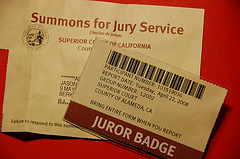
I blogged several weeks ago about recent cases in which jurors have caused a stir by using social media such as Twitter to communicate about their jury service.  Taking the issue on proactively, the Michigan Supreme Court has adopted a new rule requiring judges to admonish jurors to not use electronic communication devices during trial, and not to use them during breaks to comment or conduct research on the case.

The new rule, which takes effect September 1, 2009, adds specific admonitions to a general statement that judges must generally instruct the jurors to base their verdict only on the evidence presented in court.

(2) The court shall instruct the jurors that until their jury service is concluded, they shall not   read more »

Blog Buzzer Sounds; FTC Calls Foul

UPDATE: After making some changes from the proposal discussed below, the FTC published the new regulations in the Federal Register on Oct. 5, 2009, with the new rules scheduled to go into effect on Dec. 1.  More details here.

What do Harry Potter books, The Blair Witch Project, Razor scooters, the Ford Focus and Hebrew National hot dogs have in common? In the late 1990s and early 2000s, these brands -- or, more precisely, the marketers behind them -- were at the cutting edge of a new advertising technique: "buzz marketing." A decade later, the government's efforts to control such marketing techniques may have impact on blogs and other citizen media.

Inspired by Malcolm Gladwell's 2000 book The Tipping Point: How Little Things Can Make a Big Difference, the idea behind buzz marketing, as explained by BusinessWeek magazine in July 2001, was to eschew traditional advertisements, replacing them with "influencers" whose role is to promote a brand to a particular group of people. These "influencers" can be paid in the traditional sense, or instead they can be offered special perks and benefits, or given free samples for their own use, or to give away to others. The key is that the "influencers" do not reveal the arrangement, so that their use and interest in a product seems to be a genuine personal preference.   read more »

Crime Online May Mean More Time

In Hawaii, a 22-year-old former hospital worker was recently sentenced to one year in jail, five years probation and 200 hours of community service on a felony charge of "unauthorized computer access to confidential records" (apparently under Haw. Rev. Stat. §708-892, Computer damage in the first degree) after she obtained a patient's records stating that he was HIV-positive and gave them to the patient's sister-in-law, who posted them on her MySpace page. The prosecutor had recommended a sentence of only 30 days, but Circuit Judge Randal Lee reportedly said during sentencing that "Young people in this society have to realize that the Internet is not something that can be taken advantage of. You can't use the Internet to do unlawful conduct."

Although the patient in the Hawaii case his since died, a lawyer for his estate said that he planned to file a civil lawsuit against the former hospital worker who may face liability for the publication of private facts. (Another civil suit stemming from posting of personal medical information is Mason v. Grey, detailed in the Legal Threats database.)   read more »

Web of Justice?: Jurors' Use of Social Media

At the start of a trial, the judge usually reads to jurors general instructions about how the trial will proceed. The instructions also tell jurors how they should behave during the trial, including the admonition that they should not discuss the case with others, including both trial participants and outsiders.

But in recent years, several courts have had to deal with jurors using social media -- such as blogs and text messaging -- during trials. Although this has arisen in a surprising number of cases, so far it appears that no court has overturned a jury verdict or ordered a new trial because of such activity.

The rationale behind the standard instructions to jurors about not speaking about the case is that they shoud consider only the evidence presented in court, which must meet the rules and standards that courts impose. These jury instructions, from Arizona, are a typical exmaple of what jurors are told:

Do not talk to anyone about the case, or about anyone who has anything to do with it, and do not let anyone talk to you about those matters, until the trial has ended and you have been discharged as jurors. Until then, you may tell people you are on a jury, and you may tell them the estimated schedule for the trial, but do not tell them anything else except to say that you cannot talk about the trial until it is over. If someone should try to talk to you about the case, stop them or walk away.

If you should overhear others talking about the case, stop them or walk away. If anything like this does happen, report it to me or any member of my staff as soon as you can.   read more »

Lesson of "Communist" Libel Cases in Vietnamese Community: Know Your Audience

In the United States after the Cold War, saying that someone is a Communist may not have the same sting that it did during the the decades of tension between the U.S. and the Soviet Union, and their respective allies.

But within the past three years, courts in California, Minnesota and Washington have held that calling someone a Communist can be the basis of a valid libel claim when the audience is the Vietnamese-American community, which consists mostly of refugees who fled the Communist regime in their native land after the Vietnam War.

In 2007, the Minnesota Court of Appeals partially affirmed a defamation award to a Vietnamese-American businessman and his company, holding that "appellants' statements [in letters] that respondent Pham is a 'Communist lackey controlled by the Vietnamese Communists' are not political speech protected by the First Amendment.” Pham v. Le, Nos. A06-1127 and A06-1189, 2007 WL 2363853 (Minn. App. Aug. 21, 2007) (unpublished), cert. denied sub. nom., Van Tran v. Pham, 128 S.Ct. 1891 (U.S. April 14, 2008).   read more »

Blogger Threatened Over Ballot Photo As 19th Century Laws Meet 21st Century Technology, Sensibility

As noted in the Documenting Your Vote section of CMLP's Legal Guide, several states have laws prohibiting voters from displaying their ballots to someone else.

In Missouri, an anonymous blogger who sponsored a fake campaign for St. Louis Blues hockey player T.J. Oshie to become mayor of O'Fallon, Missouri posted a picture of a ballot with Oshie's name written in. (Although the blog remains, the photo -- available here -- has been removed.) This is an apparent violation of Mo. Rev. Stat. § 115.637 (14), which prohibits a voter from "allowing his ballot to be seen by any person with the intent of letting it be known how he is about to vote or has voted." Violation is a a class-four election offense, punishable by up to a $2,500 fine and/or up to a year in jail.

What the blogger probably saw as a harmless prank was taken seriously by St. Charles County elections director Rich A. Chrismer, who told the St. Louis Post-Dispatch that the blogger "violated the law, and I'm going to prosecute." "They may have thought the photo was cute," he continued, "but it was very serious."

Why all the fuss?   read more »

First Circuit Webcasting Argument Stems From Long History of Rules on Cameras in Courts

On Wednesday, April 8, the First Circuit Court of Appeals in Boston heard oral argument (mp3) on whether a trial of a Boston University student sued for music downloading, Sony BMG Music v. Tenenbaum, should be allowed to be webcast live. Federal district judge Nancy Gertner had agreed to allow the webcast, but the recording industry plaintiffs appealed.

Update: On April 14, the 1st Circuit issued its opinion barring the webcast. The court held that Local Rule 83.3 (discussed below) must be read in its entirety, and in light of the Judicial Conference and 1st Circuit directives on the issue, and thus limits broadcasting of court proeccedings for preservation of evidence, perpetuation of a record, or to broadcast investitive, ceremonial, or naturalization proceedings.   read more »


Copyright 2007-09 Citizen Media Law Project and respective authors. Except where otherwise noted,
content on this site is licensed under a Creative Commons Attribution-Noncommercial-ShareAlike 3.0 License: Details.
Use of this site is pursuant to our Terms of Use and Privacy Notice.