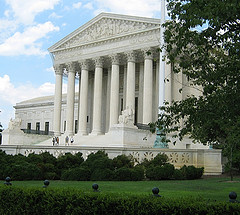


Access to Courts

Highlights from the Legal Guide: Access to Courts and Court Records

This is the eighth in a series of posts calling attention to topics we cover in the Citizen Media Legal Guide. In this post, we highlight the section on Access to Courts and Court Records, which provides an overview of federal and state laws that grant you the right to access federal and state court records and court proceedings. We also provide some practical tips for getting useful information out of your local courthouse.

If you’re hunting for information, consider a visit to the courthouse, where you can sift through resource-rich court records or attend (sometimes colorful) court proceedings.

Courts are centers for dispute resolution. They are public forums in which societal norms and values, as reflected in laws, are used to address and correct wrongs. While a number of laws govern the court system, none is so deeply-ingrained as the presumption that court proceedings should be open to the public.

If you are wondering how attending court proceedings or combing through court records might be valuable to you, here are several great reasons to consider acquiring -- and publishing -- information available from the courts:   read more »

The Smoking Gun Does the Dirty Work, Finds the Gems Others Miss

The New York Times just ran a fascinating article on The Smoking Gun, a website dedicated to providing "documents--cool, confidential, quirky--that can't be found elsewhere on the Web." The three-person investigative shop in mid-town Manhattan consistently finds -- and publishes -- court documents, government records, and other esoterica that it finds through Freedom of Information requests, court files, and good old-fashioned investigative journalism. As we explain in our legal guide, you don't need the resources of a big media organization to use these information gathering tools effectively.

According to the Times:

The Smoking Gun has demonstrated that if you obey the metabolism of the Web, not the journalist, you can land with significant impact in a hurry.

“I think one of the keys is that we are three people,” said Mr. Bastone, who founded the site with Daniel Green, another Voice alumnus who has since moved on to truTV at Turner, and Barbara Glauber, Mr. Bastone’s wife and the designer of the site. . . .

“Their secret sauce is the ability to source documents that no one else can get,” said Steve Koonin, president of Turner Entertainment Networks, which inherited the site when it bought Court TV. “It’s not a big business, but it’s profitable, and one of the things we are diligent about is the care and feeding of brands. Young people respond to this brand on TV and on the Web.”   read more »

CMLP Launches New Legal Guide Section on Access to Government Information

Back in January, we began rolling out the Citizen Media Law Project's Legal Guide. So far, we've published major sections of the guide covering Forming a Business and Getting Online, Dealing with Online Legal Risks, and Newsgathering and Privacy. This week we published the section on Access to Government Information, which highlights the extensive amount of information available through government sources and explains how both traditional and non-traditional journalists can use various public access laws to gather and make effective use of this information.

To whet your appetite, I've pasted the overview to this new section below:

Access to Government Information   read more »

It's Sunshine Week!

It’s March and it’s Sunshine Week. This year, from March 16 - 22, the American Society of Newspaper Editors is holding its annual national initiative to raise public consciousness on the need for open government. The name “Sunshine Week” is derived from the late Supreme Court Justice Louis Brandeis’s admonition that “[s]unlight is the best disinfectant,” describing his belief that an open government is more accountable to its people and thus less easily corrupted. As I write this post, various participants in the media community are similarly calling attention to the public’s right to know what their government is doing and why in order to improve their lives and better inform their communities. (See the Student Press Law Center, the Massachusetts Newspapers Publishers Association, and the Society for Professional Journalists for examples.)

Using freedom of information laws is a simple, and potentially powerful, way of obtaining information about the activities of federal, state and many local governments. You don't need to hire a lawyer, and no complicated forms are involved—requests can be made in a simple letter. And you don't need to be a journalist to share what you find with others who are interested in these issues; with nothing more than an Internet connection, you can post the information and make it available to anyone in the world.  read more »

Oklahoma Curtails Online Access to Court Records

Earlier this week, the Oklahoma Supreme Court adopted new rules governing public access to court records, cutting off all public access to court records via the Internet and limiting public access to other information that has been available in the past.

When the rules go into effect on June 10, online access to court documents in the Oklahoma Supreme Court and district courts would be limited to court dockets only and parties will be required to redact certain personal information before submitting a filing to the court clerk.

According to the order signed by Chief Justice James Winchester and four other justices, "individual pleadings and other recorded documents filed of record in state court actions shall not be publicly displayed on the Internet." The order, released on March 11, describes the new rules as an effort to balance the rights of privacy of individuals and public access.

"What I disagree with is the instantaneous restriction of public access to current public court documents on line," Justice Yvonne Kaugerin wrote in a separate opinion concurring in part and dissenting in part from the new rules. Kauger went on to note:   read more »

A.P. Request for Access to Search Warrant Affidavit Denied in Baseball Steroids Case

Written by Tom Casazzone, CMLP Intern

A federal district court in Arizona has denied a request filed by the Associated Press to reveal the names of Major League Baseball players allegedly implicated in the use of performance-enhancing drugs. In this case, which has received extensive coverage in the New York Times and elsewhere, Jason Grimsley, a former major league pitcher, supplied a federal agent with the names of ballplayers that he said used performance-enhancing drugs in the past. A federal agent used these names in an affidavit to support a warrant to search Grimsley's home last year. When the affidavit and warrant were made public in June 2006, the players' names had been blacked out. The A.P. then requested access to the entire affidavit, asking the court to reveal the names that were blacked out.

The A.P. claimed a First Amendment and common law right of access to the original affidavit. According to the Supreme Court, there is a general presumption of access to court filings, and the presumption "may be overcome only by an overriding interest based on findings that closure is essential to preserve higher values and is narrowly tailored to serve that interest." Press-Enterprise Co. v. Superior Court, 464 U.S. 501, 511 (1986). Courts therefore must apply a balancing test to determine whether the government's interest in secrecy outweighs the public interest in disclosure.   read more »

Bloggers Are Not Journalists, Illinois Juvenile Court Judge Declares

An Illinois juvenile court judge refused to allow blogger Elaine Hopkins from Peoriastory.com to observe and cover a July 25 juvenile court hearing in Peoria, IL. In excluding Hopkins from the courtroom, Judge Albert Purham, Jr. ruled that bloggers are not journalists under Illinois law. Hopkins, who covered her ouster on her website, reported:

Operating a "so-called blog" doesn't make the person a journalist, Purham said. Before the ruling he consulted the lawyers in the courtroom. A lawyer for the parent in this child welfare case had no objection, and her client, Lorraine Singleton who lost her children in 2003 and is trying to get them back, also had no objection. But assistant state's attorney Susan Lucas objected, as did an unidentified female lawyer apparently representing the Illinois Department of Children and Family Services. An explanation that Peoriastory.com has operated since February 2007, has business cards, and is run by Hopkins, a former newspaper reporter known to court personnel, did not sway the judge.

Unlike adult criminal proceedings, which are presumed to be open to the public, juvenile proceedings have traditionally been closed. See In re Gault, 387 U.S. 1, 25 (1967). Under Illinois' Juvenile Court Act, the general public, except for the "news media," are excluded from juvenile proceedings. The provision addressing access, 705 ILCS 405/1-5, states:   read more »

Whosarat.com

Interesting article in today's New York Times about Whosarat.com, which says it has identified 4,300 informers and 400 undercover agents, many of them from electronic court records.  According to a Justice Department official quoted in the piece:

We are witnessing the rise of a new cottage industry engaged in republishing court filings about cooperators on Web sites such as www.whosarat.com for the clear purpose of witness intimidation, retaliation and harassment.

Well worth a read as it touches on many interesting -- and difficult -- issues concerning privacy, access to court records, and free speech.


Copyright 2008 Citizen Media Law Project and respective authors. Except where otherwise noted,
content on this site is licensed under a Creative Commons Attribution-ShareAlike 3.0 License: Details.
Use of this site is pursuant to our Terms of Use and Privacy Notice.