

Audio
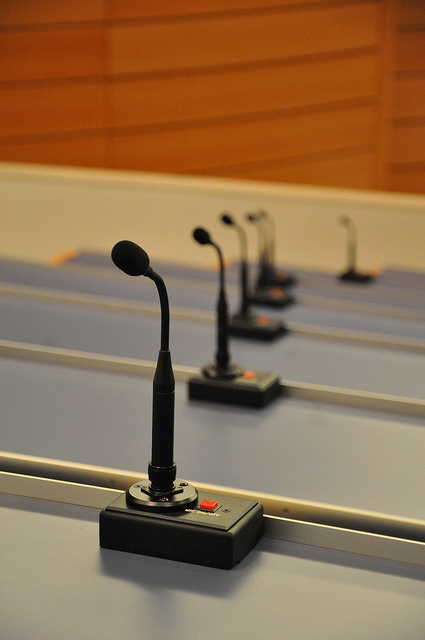 While the propriety of video and photography equipment in federal courts is subject of
 Ninth Circuit Starts Live Streaming, As Federal Camera Test Continues
 In early December, the Ninth Circuit Court of Appeals
 Boston Police Charge Two Journalists With Felonies For Doing Their Jobs
911, What's Your Emergency? Public Access to 911 Calls in California and Maine
 As California delays public access to prank celebrity 911 phone call records, a court in Maine has kicked things up a notch, pulling from one of over 500 exceptions to Maine's Freedom of
Access Act (“FOAA”) to block public access to a 911 record in connection with an
ongoing criminal trial.
As California delays public access to prank celebrity 911 phone call records, a court in Maine has kicked things up a notch, pulling from one of over 500 exceptions to Maine's Freedom of
Access Act (“FOAA”) to block public access to a 911 record in connection with an
ongoing criminal trial.
Personal Audio v. ACE Broadcasting Network

A Response to Sandy Hook: Privacy Trumps Transparency in New Connecticut Bill
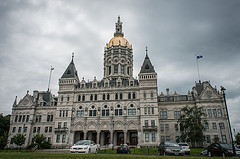 At a time when citizens increasingly call for government transparency, the Connecticut legislature recently passed a bill to withhold graphic information depicting homicides from the public in response to records from last December's devastation at Sandy Hook Elementary School.
Another Go-Round with Recording the Police in Massachusetts
 Last Thursday,
 A Camera Records in Boca, Part Two
 Today's post is a continuation of my analysis of the laws implicated by the recording of Mitt Romney's remarks at a
fundraiser held at a private home in Boca Raton, Florida, on May 17,
2012.
Today's post is a continuation of my analysis of the laws implicated by the recording of Mitt Romney's remarks at a
fundraiser held at a private home in Boca Raton, Florida, on May 17,
2012. A Camera Records in Boca, Part One
 As
is now commonly known, on May 17, 2012, presidential candidate Mitt Romney made
a series of very candid comments at a private fundraiser held in the Boca Raton
home of private equity manager Marc Leder.
As
is now commonly known, on May 17, 2012, presidential candidate Mitt Romney made
a series of very candid comments at a private fundraiser held in the Boca Raton
home of private equity manager Marc Leder.Does the DMCA's Safe Harbor Apply to Pre-1972 Sound Recordings?
 Some of the most commercially successful and popular music of all time – including the entire catalog of The Beatles – is subject to a degree of uncertainty under current copyright law in the United States due to an anomaly in the federal copyright framework with respect to older sound recordings.
DOJ's Public Statements Provide a Road Map for Citizens to Sue in Cop Recording Cases
 In May 2010, Christopher Sharp used his cell phone to record video of his friend being arrested by the Baltimore Police at the Preakness Stakes. The police demanded that Sharp surrender his phone, stating that the contents might be evidence; when the phone was returned, Sharp discovered that the video he had made, plus a number of other unrelated videos, had been deleted.
The Score in Illinois: First Amendment 2, Eavesdropping Law 1
 Once again, the CMLP is pleased to report that the First Amendment has scored an important victory in a case involving the recording of police officers in public. Last summer saw the
 Is It a Prior Restraint for Police to Delete Video of Their Conduct?
 A pedicab driver
 No, Sandra Fluke Does NOT Have a Valid Defamation Claim Against Rush Limbaugh
United States v. Megaupload Limited
Tell Us, Judge Posner, Who Watches the Watchmen?
 In what is now their
 Oh Tenenbaum - First Circuit Rules That Consumers and Pirates Subject to High Sanctions Under Copyright Act
 The draconian penalties for illegal downloaders under the U.S. Copyright Act were intended not just for commercial pirates, but for consumer-level infringers, the First Circuit ruled last week.
Bay Area Rapid Transit v. Protesters
A Victory for Recording in Public!
Digital Privacy and Your Smartphone
Pages



Description:
In 1996, James Logan applied for a patent for an "an audio program and message distribution system in which a host system organizes and transmits program segments to client subscriber locations." This patent-now held through Logan's company, Personal Audio-was issued in 2001, though the device described was never created. Logan applied for another patent, frequently referred to as the "podcast patent," in 2009. As issued in February 2012, this patent (No. 8,112,504) described a similar audio program and message distribution system, modified and described in more detail to better reflect contemporary podcasting.
In the U.S. District Court for the Eastern District of Texas on January 7, 2013, Personal Audio filed a complaint against ACE Broadcasting Network for infringement of its 2012 patent, No. 8,112,504. In the complaint, Personal Audio alleged that ACE Broadcasting infringed on the '504 patent by providing several podcasts, including "The Adam Carolla Show" podcast. Personal Audio argues that in these podcasts, ACE Broadcasting "uses servers, data storage and other Internet hardware and software in a manner that directly and literally infringes" the claim describing the apparatus for disseminating podcast episodes online. In the alternative, Personal Audio argued that even if ACE Broadcasting's podcasts were not literally infringing, patent infringment should still be found under the doctrine of equivalents.
Personal Audio amended its complaint on May 10, 2013 to "name the correct entities with respect to patent infringement." Personal Audio's substantive arguments remained the same, while the named defendants were amended to include those parties Personal Audio believed responsible for "The Adam Corolla Show": Lotzi Digital, Inc. and a partnership including ACE Broadcasting.
On July 10, 2013, Lotzi Digital filed its answer, asserting no infringement, literal or otherwise. Among its defenses, Lotzi Digital argued that the '504 patent is invalid under Patent Act sections 101 (subject matter), 102 (novelty), 103 (obviousness), and/or 112 (disclosure and enablement). Under these same theories, Lotzi Digital counterclaimed for a declaration that the '504 patent is invalid.
In response to this suit, the Electronic Frontier Foundation has started a campaign to "save podcasting" and has partnered with Harvard's Cyberlaw Clinic to investigate the '504 patent, including research of prior art that may invalidate the patent.