

Journalism
The Legal Needs of Emerging Online Media: The Online Media Legal Network after 500 Referrals
DMLP Announcement: Live Chat Session on Tax-Exempt Journalism (UPDATED)
Senate Shield Bill Is Actually Pretty Broad
 An amended bill
Instagram: Uncharted Territory for Courts and Journalists
 As a Los Angeles Superior Court prepares to break new ground concerning defamation on
 After On-Air Mishaps, Embarrassed Newscasters Turn to Copyright Law
 Whether we consider the
 Adding up to 105: The Charges Against Barrett Brown
 In December 2011, hacktivist collective Anonymous (in)famously
 In re Search of Email Account [Redacted]@gmail.com


DMLP files brief seeking First Amendment scrutiny in United States v. Auernheimer
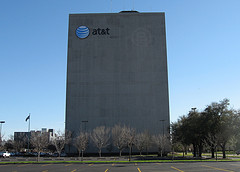 Yesterday the Digital Media Law Project, with help from the
 Baker v. Haiti-Observateur Group
The Journal News Fallout: Limiting the First Amendment to Protect the Second

Congratulations to The Lens on its Section 501(c)(3) Determination!
 The Digital Media Law Project would like to congratulate The Lens, the New Orleans area's first nonprofit, nonpartisan public-interest newsroom, on obtaining a
 No More Art Cops in Los Angeles?
 You might recall the Los Angeles Police Department's infamous
 Justice Delayed But Not Denied – Appellate Court Overturns $60K Verdict Against Blogger for Posting “Not False” Information
Suffolk County Police Department v. Datz
Johns-Byrne Company v. TechnoBuffalo
A Look Back at 2011
Antioch University v. The Antioch Papers
CMLP Guide to Reporting on Occupy Protests Goes Mobile!





Description:
James Rosen is a national news journalist for the Fox News Channel. On June 11, 2009, Rosen published an article on www.foxnews.com entitled "North Korea Intends to Match U.N. Resolution with New Nuclear Test." His Gmail email account is referenced in the case's court documents as "Redacted@gmail.com."
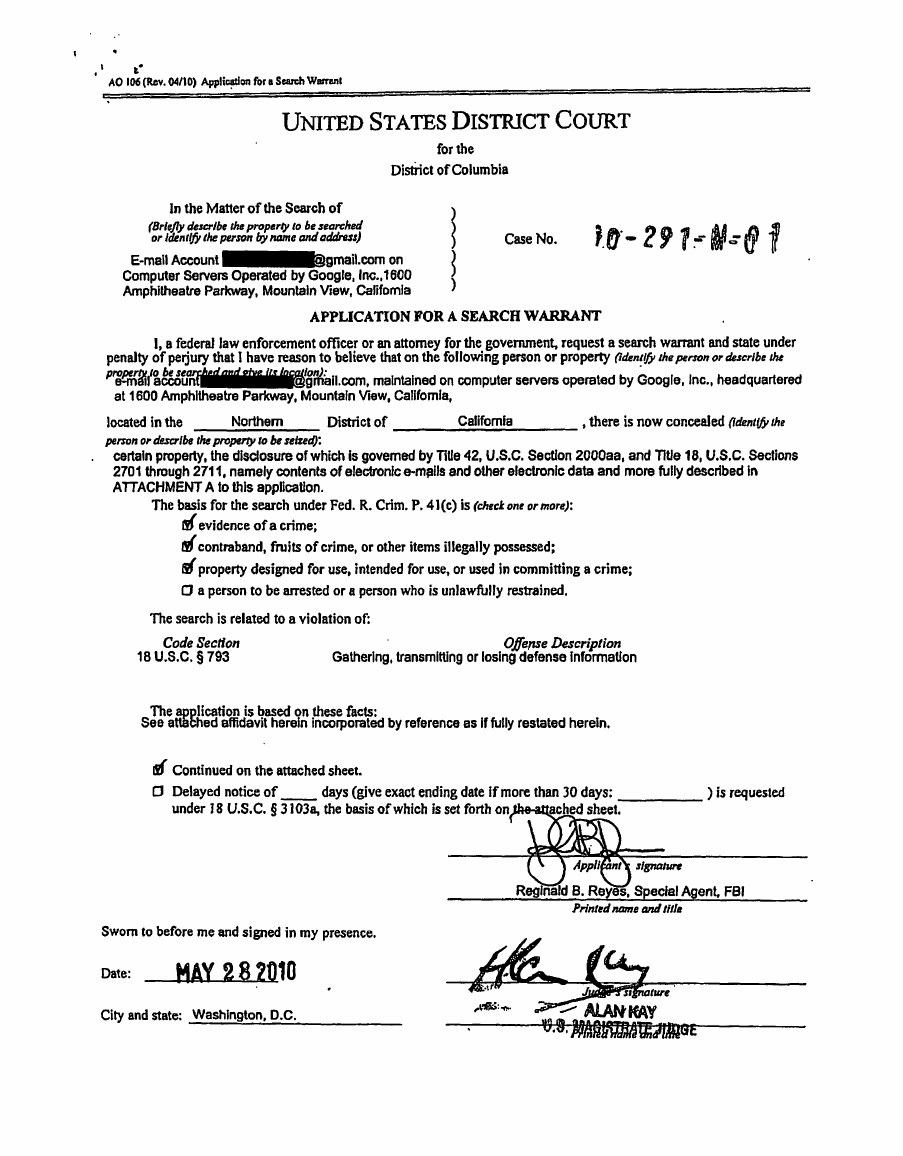
On May 28, 2010, Reginald B. Reyes, a Special Agent for the FBI filed an application for a search warrant for James Rosen's Gmail account, which was maintained by servers located at Google's headquarters in California. The search warrant application stated that the emails concealed information which, under Fed. R. Crim. P. 41(c), contained: (1) evidence of a crime; (2) contraband, fruits of crime, or other items illegally possessed; and (3) property designed for use, intended for use, or used in committing a crime. The warrant application stated that the search was related to a violation of 18 U.S.C. § 793, which governs the "gathering, transmitting or losing defense information."
The search warrant application included an affidavit by Agent Reyes in support of the search warrant. Reyes' affidavit said the warrant was pursuant to 18 U.S.C. § 2703 and 42 U.S.C. § 2000aa and permissible as the U.S. District Court for the District of Columbia has jurisdiction over the offense under investigation. Reyes states that he believes there is probable cause that Rosen violated Section 793(d) as an aider and abettor and/or co-conspirator to Stephen Kim.
That same day, a search and seizure warrant was issued by a U.S. Magistrate Judge to be executed on or before June 11, 2010. The warrant granted the search of electronic e-mails and other electronic data of Rosen's account, and permitted the officer executing the warrant to delay notice to Rosen for 30 days under 18 U.S.C. § 2705. An attachment to the issued warrant stated that Google, Inc. was not permitted to notify "any other person, including the subscriber(s) of Redacted@gmail.com" of the warrant's existence. Google, Inc. was required to make exact duplicates of all information from the email account and send this information to Agent Reyes in overnight mail or facsimile. The attachment asked for any commuications between Rosen's account and 3 other accounts, including anothe Gmail account and two Yahoo! mail accounts; the usernames of all three accounts are also redacted in the public record. The warrant attachment referenced Rosen's connection to Stephen Kim, who was under investigation by the FBI for allegedly telling a reporter that North Korea may test a nuclear bomb.
On May 21, 2013, the government filed a motion to unseal entire docket of Rosen's case, including the application for the search warrant, the attachment to the warrant, Reyes' affidavit, and the granted warrant, with only names and dates of birth redacted for privacy reasons.
On May 22, 2013, the court granted the government's motion in a memo and order that directed the case to be a matter of public record. The memo detailed clerical errors which stalled the placement of the redacted warrant and related materials into public record. The memo apologized for the administrative errors and instituted the inclusion of a new tab on the Court's website solely for the publication of search warrants. Executed warrants will be part of the public record unless a "separate sealing order is entered to redact all or portions" upon a showing by the government as required by United States v. Hubbard, 650 F.2d 293 (D.C. Cir. 1980) and Washington Post v. Robinson, 935 F.2d 282 (D.C. Cir. 1991).
In a separate order that same day, the court ordered that the Clerk place on the public docket a redacted version of the government's motion to unseal entire docket and that the government produce unredacted versions of all unsealed material to the defense in United States v. Stephen Jin-Woo Kim.
-->